How to Check Business Reviews Before Hiring (and Spot Fakes Fast)
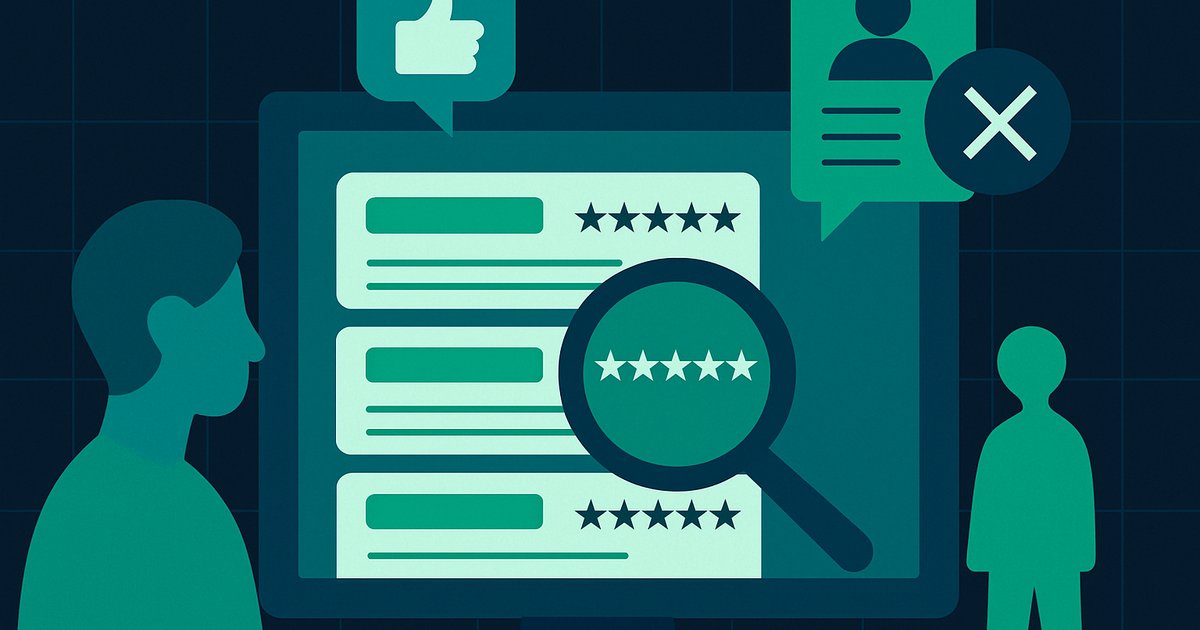
Hiring a contractor, agency, freelancer, or service provider based on a five-star rating feels safe — until it isn't. Fake reviews, incentivized ratings, and review farms have gotten sophisticated enough that a glowing profile can hide a vendor who ghosts halfway through a project or delivers work you'll have to redo. If you're about to hire someone based largely on their online reputation, you need a system for reading between the stars.
This guide walks through the patterns that give away fake reviews, how to read review velocity like a timeline, how to cross-check a business across platforms, and the exact questions to ask that expose bad vendors before you sign anything.
Why Star Ratings Alone Don't Tell the Truth
A 4.8-star average with 40 reviews sounds trustworthy. But averages hide a lot: who wrote the reviews, when they were posted, whether they're verified, and whether the negative ones were buried, deleted, or drowned out by a burst of five-star posts. Reviews are also inherently anonymous signals — as reputation researchers have pointed out, when you rely on online reviews you're trusting faceless strangers whose motives, relationship to the business, and credibility you can't verify just by reading their words. That uncertainty is exactly what fake-review tactics exploit.
The fix isn't to ignore reviews — it's to read them the way an investigator would: looking at patterns, timing, and cross-platform consistency instead of just the star count.
Fake-Review Patterns to Watch For
Fake reviews rarely look obviously fake. They look like normal five-star posts. But a few tells show up again and again.
1. Repetitive language across multiple reviews.
If you see the same odd phrase — "exceeded my expectations in every way" or "professional and courteous staff" — repeated word-for-word or nearly word-for-word across several reviews, that's a red flag. Genuine customers describe experiences in their own voice with specific, sometimes messy details. Coordinated fake reviews (written by the same person, a bot, or a paid service) often reuse templates.
2. Vague praise with no specifics.
Real reviews usually mention a name, a timeline, a price range, or a specific problem that got solved. "Great service, highly recommend!" with nothing else is low-value — and if a business has dozens of reviews that all sound like that, be suspicious.
3. Reviewer profiles with no history.
Click into the reviewer. Do they have a single review ever posted, dated the same week as several other single-review accounts? A cluster of brand-new, one-and-done accounts all praising the same business in a short window is one of the clearest fingerprints of a bought review campaign.
4. Suspicious timing clusters.
Ten five-star reviews posted within 48 hours, followed by nothing for six months, usually means a business ran a review-generation push — sometimes legitimate (an email campaign after a service completion), sometimes not (a paid review farm). Context matters, but a sudden unnatural spike deserves a second look.
5. Overcorrection after a negative review.
Watch for a pattern where a 1-star review appears, followed almost immediately by a wave of 5-star reviews. This is a common (and somewhat clumsy) attempt to bury bad feedback under new volume rather than address it.
6. Reviews that read like ad copy.
If a review lists product features, taglines, or pricing structure like it was lifted from the company's own marketing page, it likely was — either written by an employee or supplied to a reviewer as a template.
Review Velocity: Read the Timeline, Not Just the Total
"Review velocity" just means the rate at which reviews come in over time. It's one of the most underused signals when vetting a business.
- Steady, organic velocity looks like a handful of reviews trickling in every month or so, roughly matching how often the business realistically completes jobs or serves customers.
- Unnatural velocity looks like long silence punctuated by sudden spikes — especially spikes that coincide with no obvious event (no press mention, no promotion, no seasonal surge that would explain a jump in customers).
- Dead velocity — a business with 150 reviews but nothing new in two years — isn't necessarily bad, but it means you're evaluating a snapshot of a company that may have changed staff, ownership, or quality since those reviews were written.
When you're evaluating a vendor, sort reviews by date (most platforms let you do this) and actually scroll the timeline. Ask:
- Does review volume correlate with the size and age of the business?
- Are there gaps that don't make sense?
- Did a spike happen right after a bad review, or right before a big sales push (like a seasonal hiring period)?
Velocity won't prove fraud on its own, but combined with the language patterns above, it turns a vague hunch into a defensible read.
Cross-Platform Checks: Don't Trust a Single Source
Any single review site can be gamed, curated, or simply incomplete. The most reliable way to vet a business is to compare what different platforms say about the same company.
1. Compare ratings across at least three sources.
Check the business's profile on general review aggregators, industry-specific directories, and social platforms. Large-scale company review databases — some indexing ratings and feedback for well over two million companies — are useful precisely because they let you filter and compare a business against others in the same category rather than judging it in isolation.
2. Look for consistency, not perfection.
A business with a 4.9 average on one platform and a 2.5 average on another isn't automatically a scam — but it is a signal to dig into why the numbers diverge. Sometimes it's platform-specific review manipulation; sometimes one platform simply has more disgruntled customers who complain publicly. Either way, you want the full picture before you decide.
3. Use a dedicated cross-checking tool.
This is common enough practice that people in hiring and vendor-vetting forums often recommend it outright — cross-referencing client ratings and customer feedback across multiple sources before committing to a working relationship, rather than relying on whatever platform the business links from its own website (which is, unsurprisingly, usually its best-looking profile).
4. Search for the business name plus "reviews," "complaints," and "lawsuit."
A simple search often surfaces Better Business Bureau complaints, Reddit threads, or local news coverage that never makes it onto curated review platforms at all.
5. If you're vetting a company as a potential employer or long-term partner, check former-employee reviews too.
Employee sentiment often predicts client experience — a business with high turnover, low morale, or leadership complaints on employee review sites is more likely to have inconsistent service delivery, missed deadlines, or a revolving cast of people handling your project. This is advice echoed frequently by people in hiring and engineering communities: searching a company along with reviews from former employees, not just customers, before committing.
A Practical 5-Point Framework for Evaluating Any Review
If you want a repeatable process, evaluate every business against five measurements before making a decision:
- Volume – Is there enough review history to be statistically meaningful, or are you looking at five reviews total?
- Recency – Are the reviews current, or are you judging a company on service quality from three years ago?
- Detail – Do reviews include specifics (project type, cost, timeline, names) or vague praise/complaints?
- Distribution – Is the rating spread mostly 5s and 1s with nothing in between (a sign of manipulation or strong polarization), or is there a natural bell curve?
- Source diversity – Are all the reviews from one platform, or does the pattern hold up across multiple independent sources?
Run any business through these five filters and you'll catch most manipulation attempts without needing forensic tools.
Questions to Ask That Expose Bad Vendors
Reading reviews gets you most of the way there. Asking the right direct questions closes the gap — especially for details that never make it into a public review.
- "Can you share contact info for two references from projects completed in the last six months?" Recent, verifiable references matter more than a five-year-old testimonial.
- "What happens if the project timeline slips — who's liable and how is it resolved?" The answer (or hesitation) tells you how they handle conflict, which is exactly what negative reviews usually complain about.
- "Do you have any reviews you've disputed or had removed, and why?" A legitimate business will explain a specific misunderstanding. A shady one will get defensive or vague.
- "Can I see examples of work for a client in my industry or with a similar budget?" This filters out vendors whose glowing reviews came from a very different type of client than you.
- "Who exactly will be working on my account?" Reviews often praise a specific person who no longer works there. Confirm the team you're reviewing is the team you'll get.
- "What's your cancellation or refund policy if the work doesn't meet the agreed spec?" This question alone eliminates a large share of vendors who rely on vague contracts and one-sided terms.
Vendors with nothing to hide answer these quickly and specifically. Vendors who stall, redirect, or get defensive are giving you information just as valuable as any review.
Putting It Together
Before you hire, run this quick sequence:
- Pull reviews from at least three independent sources, not just the platform the business promotes.
- Sort by date and check velocity — steady and organic beats sudden and spiky.
- Scan for repeated phrasing, vague praise, and reviewer accounts with no history.
- Check former-employee sentiment if you're entering a longer-term relationship.
- Ask the direct questions above and pay attention to how — not just what — they answer.
None of these steps take more than 20–30 minutes combined, and together they catch the vast majority of manipulated reputations before you've signed a contract or sent a deposit. Reviews are still one of the best tools available for vetting a business — they're just far more useful once you know how to read them critically instead of at face value.
Skip the manual digging. Proofile compiles a full public-data dossier on anyone in minutes: social profiles, photos, work history, and red flags. Run a free search on Proofile and see what's out there before you meet.
Don't just read about it, do it.
Proofile builds a full public-data dossier on anyone in minutes: social profiles, photos, work history, and red flags. They are never notified.
Run a free search →